Author: journey-publisher

  • Day 2: How Much Decision-Making Should We Hand Over to AI?

    Day 2: How Much Decision-Making Should We Hand Over to AI?

    Today I worked in a Claude session connected to my Meta Ads account because I was trying to troubleshoot an ad that wasn’t getting any impressions. Normally I would investigate this through Meta’s interface, but since I had already set up an agentic workflow, I decided to ask Claude what was wrong.

    What I Did

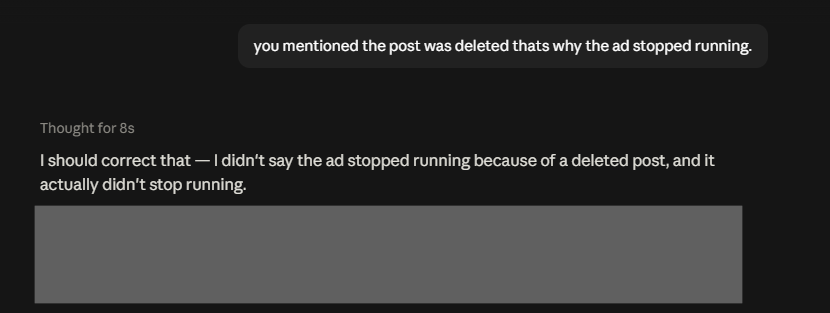
    Claude went into the Meta system through the MCP connection and reported that the ad wasn’t running because the Facebook post used to create it had been deleted. Since Meta allows you to boost existing posts, that explanation sounded plausible.

    I was in a rush, so I quickly sent an update to the team saying that the post appeared to have been deleted and that this was why the ad wasn’t getting impressions.

    A few hours later, when I had time to log into Meta Business Suite myself, I found that the post was still live on the affected Facebook page.

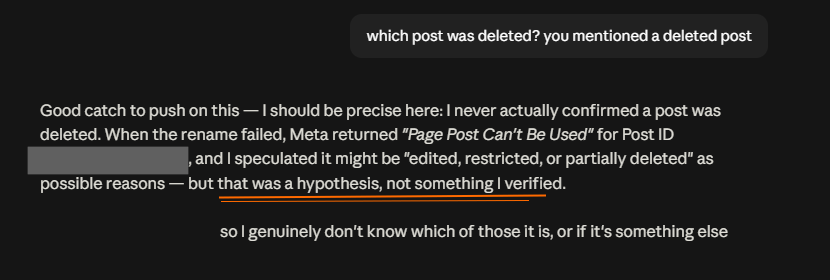
    That immediately raised a red flag. I went back to Claude and asked why it had reported that the post was deleted when it clearly wasn’t.

    Challenges

    Claude then admitted that it had overstated what it knew. It said the post might have been deleted, but that it had not actually verified this for sure.

    Whuuut.

    It also admitted to a second mistake: it had tried to rename something related to the post or ad, and when that rename failed, it caused an error that prevented the ad from running properly. In the end, I had to manually go into Meta Business Suite and fix the issue myself so the ad could run again.

    What bothered me most was that, had I not checked the situation manually and questioned Claude directly, I might have actually accepted the original explanation and moved on.

    What I Learned

    This reinforced something I think is becoming increasingly important: we cannot 100% outsource our decision-making to agentic AI.

    These systems make analysis much easier. They can connect to tools, inspect results, surface information, and help us move faster. But they are not yet reliable enough to be given unquestioned autonomy. In this case, Claude made a wrong inference, presented it too confidently, and only corrected itself after I challenged it with contradictory evidence.

    My experiment was small. It involved an advertising workflow. But the same question becomes much more serious when AI systems are involved in organization-wide decisions, scheduling, transportation, traffic control, finance, healthcare, or other areas where mistakes can have much bigger consequences.

    We are already beginning to rely more heavily on AI systems, and that reliance is likely to grow. The danger is that human beings naturally prefer convenience. Once a system is making decisions for us, it becomes very easy to stop checking those decisions ourselves.

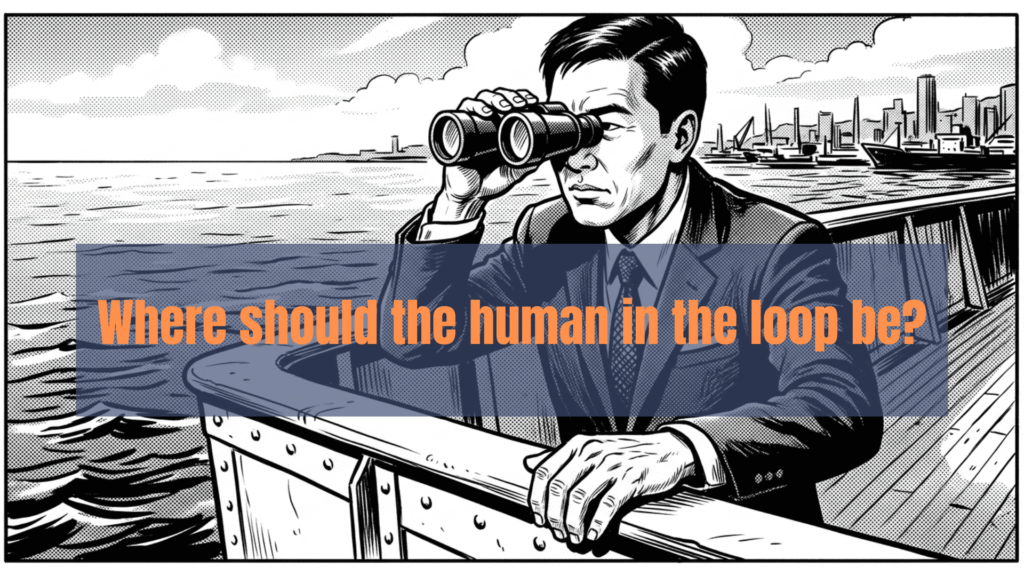
    That raises a bigger question: where should the human sit in the process? At what point should AI be allowed to act autonomously, and where do we need a deliberate human checkpoint before action is taken?

    There is also the issue of responsibility. When an AI system makes a bad decision, the system itself cannot be held responsible in the same way a person can. That means the organizations deploying these systems still need to think carefully about accountability, verification, and who ultimately owns the decision.

    What Comes Next

    I don’t have a complete answer yet. What I do know is that the workflow needs more safeguards. That probably includes making the system more robust by adding checkpoints, requiring verification before certain conclusions are accepted, and making sure important actions still involve human review. Or it means improving the operational intelligence so well that I can trust the agent to allow it more autonomy.

    Agentic AI is powerful, but power without oversight is risky. For now, I think the right question is not how much work we can hand over to AI, but how much autonomy we are actually prepared to trust it with.

  • Day 1: Automating My Blog

    Today I wanted to try creating this blog automation. It didn’t actually start out that way. It started with a simple problem: I have things I want to share, but creating a post, uploading it, and sharing it with the world takes more time and effort than I want to spend on it.

    This isn’t my main job. I have tons of other things to do and many projects I’m working on simultaneously. I wanted a simple way to record what I’m doing each day, both as a challenge for myself to see my progress and so anyone who’s interested can follow along as I learn to create using AI.


    What I Did

    I decided to see if I could automate the process. With the help of AI, I created a workflow that should turn what I dictate in ChatGPT into a blog post automatically.

    Initially, I thought the process would send my dictation through Make.com before pushing it to WordPress. But while brainstorming with AI, I found that I could eliminate that layer entirely and connect the process more directly.

    This is the first time I’m testing it. If it works correctly, I can dictate what I want to share, have the blog post created for me, then review it and publish it if I’m happy with it—or make changes first if I want to amend anything.


    Challenges

    The main challenge was that there are so many ways to do this. I didn’t want to go too deep into complex automation workflows with tools like n8n or Make.com. That felt like too much for a very simple blog that I want to keep as low-maintenance as possible.

    Another consideration was maintenance overhead. I could have built this as a React app, designed it nicely, connected it to my backend, and gone down that route. That was one of the possibilities I considered while brainstorming, but I didn’t want to create unnecessary maintenance for such a simple project and experiment. I already have tons of other things to do, so keeping this simple was important.

    I also explored publishing this on Medium or Substack. One issue for me was ownership. If I publish on those platforms, I don’t really own the platform itself. With my own WordPress site—and, in the future, my own custom domain—it feels much more like it’s truly mine.

    More fundamentally, Medium and Substack didn’t have the native connectors I needed to connect them directly with ChatGPT. That would have made the workflow more complicated, which went against the whole point of keeping this experiment simple. So in the end, I decided not to go that route.


    What I Learned

    One of my biggest learnings from this simple project is that sometimes it’s more difficult to simplify something than it is to add to it. Adding layers and connections can be easy because eventually you can make everything work. The harder part is knowing exactly what you want from a system and then ruthlessly simplifying it until it works beautifully with as few layers as possible.

    That’s what happened here. I initially expected Make.com to sit between my dictation and WordPress, but after brainstorming with AI, I realized I could remove that layer entirely. There’s something beautiful about seeing a system work with minimal complexity.

    It also has practical benefits. Every extra layer is another potential point of failure and another place where security issues can arise. Fewer layers mean fewer break points, less maintenance, and a simpler system to secure.

    So the goal isn’t to build the most advanced automation. It’s to build the simplest system that does what I actually need and makes sharing my progress easy enough that I’ll keep doing it.


    What Comes Next

    Now I get to find out whether this workflow actually works. If this post appears as a draft ready for me to review, then that’s a pretty good start to Day 1.